DEVLOG
From Train Hazard to Boss System: Scrapmaster ZX-3
How we built a configurable train system for Lynked: Banner of the Spark to create a boss encounter that felt like a natural evolution of everything players had learned throughout the level.
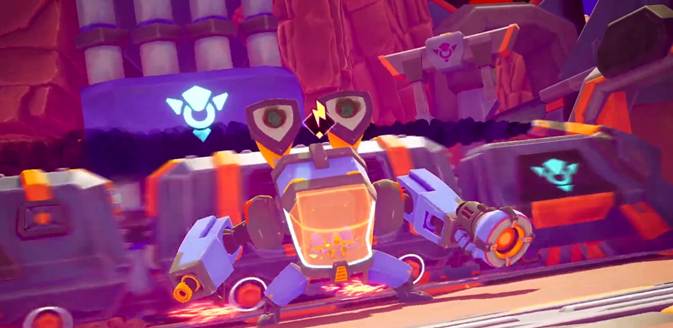
Designing a Boss Around the Faction
Good boss fights shouldn't introduce random mechanics. They should be the culmination of everything players have learned.
In Lynked: Banner of the Spark, every biome introduces a new enemy faction and builds toward a unique boss encounter. In the second biome, Sludgestone Ridge, players battle through the Scrapper hierarchy: first swarms of Scrapper Bots, then Guard Bots—mechanized units piloted by Scrappers—and finally Scrapmaster ZX-3, a massive mech piloted by three Scrappers. We wanted the final encounter in Sludgestone Ridge to feel like the natural evolution of the entire Scrapper faction.
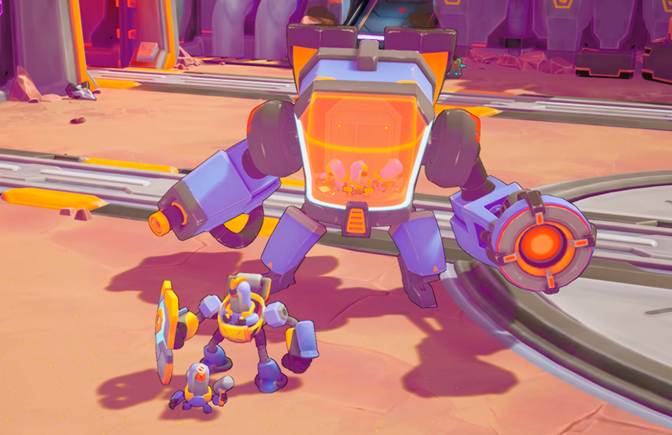
Turning the Trainyard Into a Boss Mechanic
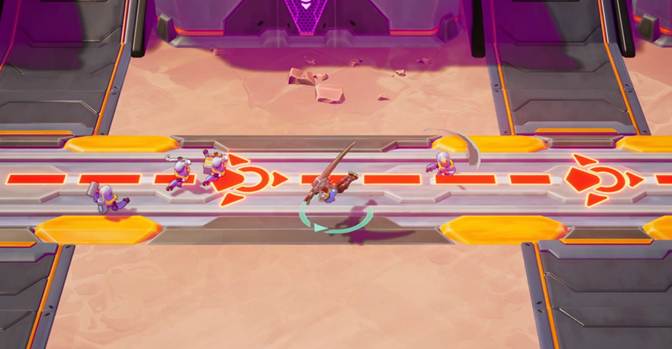
Because the boss fight was centered in an active trainyard, we wanted the environment itself to become part of the encounter. I built a configurable train hazard that could serve two distinct purposes.
Some trains were high-speed hazards that forced players to reposition. Others slowed into the station, unloaded Scrapper Bots or Guard Bots, and then pulled away. This let Scrapmaster feel like he was commanding the same army of enemies players had encountered throughout the biome.
Animation-Driven, Gameplay-Configured
The Scrapmaster call-in animation fired an event carrying a small set of Gameplay Tags, such as BulletTrain, SpawnScrappers, or SpawnGuardBots. We put the events in the animation to reinforce that the Scrapmaster's actions were triggering the train spawn. The events were sent to the Train Spawner actors in the level, and their Blueprints owned the gameplay logic.
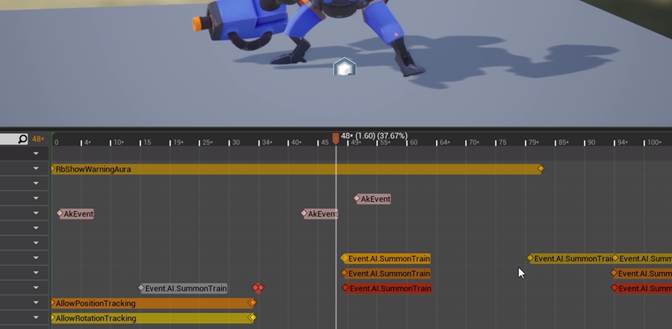 | 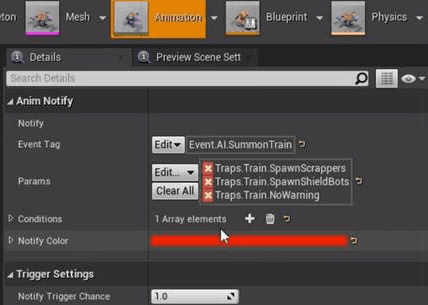 |
The spawner interpreted those tags and configured the train, selecting the payload and behavior while dynamically scaling reinforcement counts based on player count, boss phase, and the number of enemies already active in the arena.
Once the train is configured and spawned, the reinforcement enemies are spawned and attached to sockets on the train's flatbed. When the train reaches its stop, it fires a callback event to the attached enemies, triggering their scripted "leap from the train" animation and activating their AI brains. From there, they transition seamlessly into their normal systemic combat behavior.
Designing for Readability
Playtesting quickly showed that a train entering the arena at high speed needed a strong telegraph. We used a warning-arrow VFX to indicate the hazard area, with additional audio cues when players were near the tracks.
The isometric camera created another challenge. Enclosed box cars could occlude too much gameplay, so reinforcement trains used open flatbeds where players could clearly see the enemies being transported. Box cars worked better for the fast-moving bullet train because they did not remain in the arena.
Knowing What Not to Use
The system also supported spawning mobile projectile traps mounted to the traincars that could create a bullet-hell effect. Although the feature worked technically, playtesting showed that it added too much noise and chaos alongside Scrapmaster's attacks, reinforcement swarms, and the train hazard itself.
We removed the feature from the boss encounter. The lesson was simple: a flexible system is valuable, but not every capability belongs in every encounter.
From Boss Mechanic to Biome System
The train system ultimately worked so well that we expanded it beyond the boss fight and reused it throughout Sludgestone Ridge as a recurring environmental hazard.
What started as a boss mechanic became a reusable gameplay tool that reinforced the Scrapper faction's identity, gave designers a flexible encounter system, and helped make Scrapmaster ZX-3 feel like the natural evolution of everything players had experienced throughout the biome.
Key Takeaways
For me, the biggest takeaway was the value of building configurable systems. The ability to quickly change train behavior, enemy payloads, spawn counts, and scaling made it much easier to test, tune, and balance the encounter across different player compositions and boss phases.
But the system also reinforced a larger design principle: the best boss fights evolve from what players have already learned. By using the Scrapper faction, their hierarchy, and the train infrastructure established throughout Sludgestone Ridge, Scrapmaster ZX-3 felt like a natural escalation of the world—not a collection of mechanics introduced just for the final fight.