DEVLOG
Body Billiards: Designing Controlled Chaos
A chain-reaction combat system for Lynked: Banner of the Spark Co-developed with Gameplay Programmer Jake Warmerdam
Turning Enemies into Projectiles
One of the combat systems I worked on for Lynked: Banner of the Spark was a chain-reaction system we called Body Billiards. The goal of Body Billiards was to make every enemy reaction an opportunity for the player—and make that reaction feel incredibly satisfying. We wanted exaggerated, over-the-top impacts where every hit had weight: metal bodies colliding with a satisfying crunch, enemies getting launched across the battlefield, and one impact setting up the next. A hit shouldn't necessarily end the interaction—it could become the setup for another attack, another enemy, or an environmental hazard.
The system turns enemy reactions into potential projectiles, allowing impacts and reactions to propagate through the battlefield. This created chaotic, physical combat moments while giving players more tools to strategically position enemies and build larger combos.
The Design Goal
The goal was not simply to make enemies bounce around. We wanted the system to create opportunities for the player—giving them more ways to strategically position enemies using all their abilities to set up chain reactions.
That led to a useful design principle: controlled chaos. Each attack and ability had predictable, readable reactions that players could learn and master. Once they understood those reactions, they could start thinking several interactions ahead—using one enemy to take out another, redirecting that enemy into a hazard, and setting up the next reaction like a game of billiards. The fun came from giving players enough control to plan the first few shots, then letting the resulting chain reaction play out in spectacular, unexpected ways.
Designed for Player Expression
Body Billiards was designed to work alongside the grapple hook, one of Lynked’s core mechanics. The grapple gave players a way to interact with enemies from a distance, pull them into position, and then attack them up close or launch them into a crowd to start a cascade.
The goal was expressive combat: give players multiple ways to manipulate the battlefield through the grapple, traversal actions, and combat abilities, then let those systems combine to produce large, satisfying chain reactions.
How the System Works
1. Find Potential Targets
When a reaction triggers, the system performs an overlap check in the direction of travel. This gathers nearby enemies and environmental hazards that could potentially become part of the reaction.
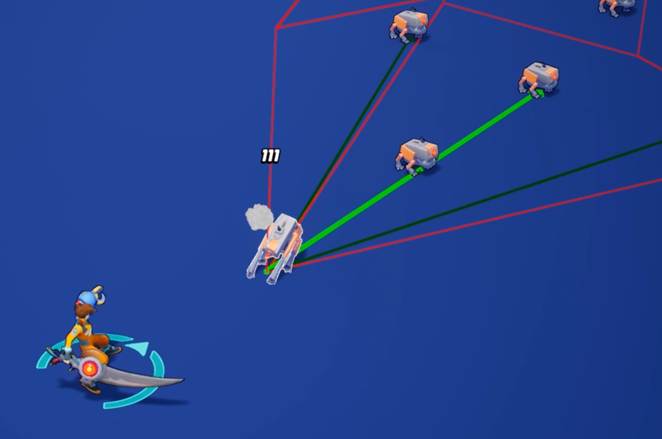
2. Choose the Best-Aligned Target
From the candidates, the system selects the target most closely aligned with the current velocity. Rather than simply choosing the nearest object, it uses the angle between the current trajectory and each candidate to determine which target makes the most sense for the reaction. Those candidates could be enemies as well as traps and other environmental hazards.
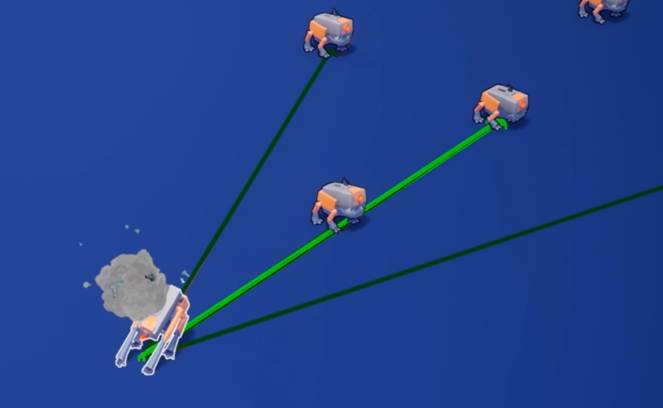
3. Aim and Launch the Next Reaction
Once a target is selected, the reaction is aimed and launched along that path, preserving the sense of momentum and direction. This makes the chain feel like a continuation of the original impact rather than a series of unrelated events.
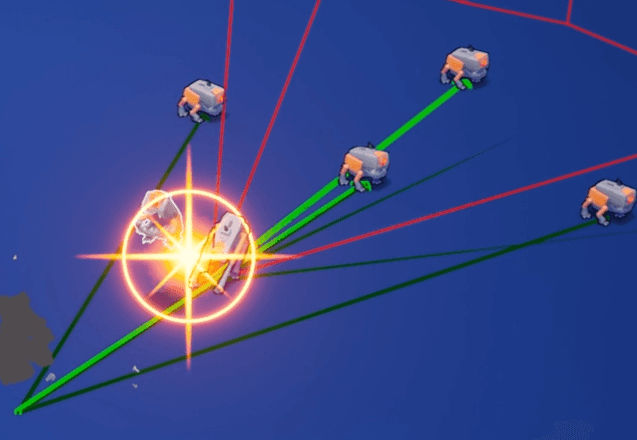
4. Propagate the Reaction
Damage and reaction states then propagate through each valid impact. An enemy could be launched into another enemy, explosive trap, or other environmental hazard.
This meant the player was not just chaining enemies together, but using the entire combat space as a potential source of the next reaction.
Why It Feels Good
The system created a feedback loop between player positioning and the physical layout of the encounter. Players could reposition enemies, line up reactions, and identify hazards that could become the next link in the chain. A grapple could pull an enemy into position, an attack could launch it into another enemy, and that enemy could trigger an explosive barrel—turning a single interaction into a much larger combat payoff.
Because these interactions were driven by the same predictable rules rather than a scripted sequence, players could learn the system and start planning several moves ahead. The resulting chains were different from encounter to encounter, but the player always understood why they happened—and could get better at creating them.
The Result: Controlled Chaos
Body Billiards turned simple combat interactions into opportunities for emergent crowd control. Players are rewarded for positioning, timing, and combining all their abilities, turning the battlefield into a reactive space where combat expression emerges from physics and placement.
The system's value was not just the spectacle of a large chain reaction. It gave the player another way to think about combat: enemies could be targets, obstacles, and potential weapons depending on where they were standing.
Key Takeaways
Strategic repositioning: Give players tools to move enemies into advantageous positions and create opportunities.
Player expression: Encourage players to combine the grapple, abilities, and environment to create their own chain reactions.
Combat feedback: Make enemy reactions a meaningful part of the attack payoff, rewarding the player with opportunities to continue the interaction.
Controlled chaos: Keep the system readable and predictable enough to master while allowing enough variation for surprising outcomes.